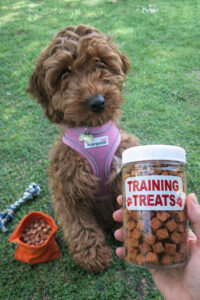
Welcome to the world of high-value vs. low-value dog training treats.
We’ve all been there: you’re at the park, you call your pup’s name, and they look at you, look at a passing squirrel, and decide the squirrel is infinitely more interesting.
Don’t take it personally! Your dog isn’t being “naughty”—they are just doing some quick canine maths. In that moment, the reward of chasing the squirrel outweighed the reward in your pocket.
If you want a dog that chooses you over the distractions of the world, you need to understand the economy of dog training. Welcome to the world of High-Value vs. Low-Value treats.
The Canine Economy: How Dogs Value Rewards
Dogs are opportunists. They do what works, and they work for what pays best. To get the behaviour you want, you have to pay them according to the difficulty of the job.
-
Low-Value Treats: Think of these as the £1 coins of the dog world. They are great for everyday bonuses.
-
High-Value Treats: These are the £50 notes. They are rare, incredibly exciting, and reserved for big breakthroughs.
If you try to pay your dog a pound coin to ignore a bounding deer, they’re going to go on strike. But offer them a fifty-pound note? Now you have their full attention.
High-Value vs. Low-Value: A Quick Cheat Sheet
Not sure which treats fall into which category? Here is a general breakdown of how most dogs rank their rewards:
| Treat Value | What It Is | Best Used For |
| Low Value | Everyday kibble, plain crunchy biscuits, or ice cubes. | Indoor training, mastered commands, or casual “good boy” moments. |
| Medium Value | Our meaty training treats, veggies (like carrots), or fruit. | Moderately distracting environments (the garden) or learning new basic tricks. |
| High Value | Smelly, freeze-dried meats, fresh chicken, cheese, and our fantastic range of natural training treats. | High-distraction environments (the local park), recall (coming when called), and behavioural training. |
Pro Tip: Value is in the eye of the beholder! While most dogs love smelly meat, some quirky pups might consider a piece of broccoli a high-value jackpot. Pay attention to what makes your dog’s tail wag the fastest.
3 Golden Rules for Using Treats in Training
1. Match the Treat to the Environment
If you are practising “sit” in your quiet lounge, your dog’s regular kibble will work just fine. But the second you step outside where there are cars, people, and strange smells, you need to upgrade to the high-value stuff to compete with the environment.
2. Keep High-Value Treats Small
High-value training treats should be about the size of a pea. You want your dog to swallow it quickly and look to you for more, not spend three minutes crunching on a massive biscuit and forgetting what they were doing in the first place.
3. Avoid “Bribery”
There is a big difference between a reward and a bribe.
-
Bribery: Showing your dog the treat before asking them to do something because they won’t do it otherwise.
-
Rewarding: Asking for the command, your dog doing it, and then pulling the treat out of your pouch.
Looking for the Ultimate Training Secret Weapon?
If you’re struggling to find that “jackpot” treat that makes your dog completely forget about the rest of the world, we’ve got you covered.
Our training treat range are packed with real, smelly, irresistible flavour that dogs can sniff out from a mile away. They are perfectly sized for quick-reward training, healthy enough that you don’t have to worry about extra calories, and guaranteed to make your next training session a massive success.